
Searching Iowa County Criminal Dockets
Wisconsin Circuit Court Access, or WCCA, is the fastest way to pull a public Iowa County criminal docket online. Enter the full case number if you have it. No number? Search the party name and pick Iowa County. Filter by case type only when the list gets long. A matching name proves little on its own. So check the county, caption, filing date, branch, status, and recent events against whatever notice you hold.
When WCCA leaves you stuck, the Iowa County Clerk of Circuit Court is the fallback for everything. Call (608) 935-0395, or stop at the counter in Dodgeville at 222 N. Iowa Street. You can also mail a narrow request to that address. A public-access computer sits at the counter too. That matters for old files, for copies of a filed paper, or whenever the online docket raises more questions than it answers.
- Identify Iowa County Circuit Court as the forum.
- Search the complete number, or use name and county.
- Match the class, filing date, branch, and caption.
- Read events and future settings in date order.
- Ask the clerk for the paper or certified copy.
Iowa County WCCA Search Fields
The Wisconsin case-search landing page splits the work. Trial matters go to WCCA, and appeals go elsewhere. Labels shift over time. What stays steady is the logic of name, case number, county, and case classification. Enter only what it takes to land on the right public case.
| Field | Best use | Check |
|---|---|---|
| Case number | Exact lookup | Copy each digit and class code |
| Name | Possible matches | Confirm county and filing date |
| County | Limits statewide results | Select Iowa County |
| Case type | Narrows the class | Separate felony, misdemeanor, and criminal traffic |
Searching costs nothing. Fees apply to copies and certification, not to ordinary WCCA use. Keep birth dates, account numbers, and state IDs out of any public note, since those details stay protected.
Inside an Iowa County Criminal Docket
Think of an Iowa County criminal docket as an event register. It is not the evidence file. The header carries the essentials: county, case number, filing date, branch, class, caption, official, and status. From there, the history may list the complaint, notices, hearings, motions, orders, pleas, judgment, restitution, and payments. Anything scheduled ahead shows the date, time, hearing type, and assigned court.
| Case number | A Wisconsin identifier such as 2026-CF-000123; read the live code. |
|---|---|
| Charge | An allegation and statute, not a finding of guilt. |
| Settings | Appearance, arraignment, pretrial, motion, trial, or review. |
| Plea and orders | Responses and court directions. |
| Disposition | Dismissal, conviction, sentence, or another result. |
A one-line label hides the reasoning. When the exact wording matters, request the order or judgment behind the entry.
Iowa County Criminal Docket Terms
Each term on a docket marks a distinct stage, so none are interchangeable. A charge is only an accusation. A plea is the formal answer to it. The disposition records the final outcome. Payment, review, or appeal events can still show up after a disposed status.
- Initial appearance
- The first event addressing the case and release issues.
- Arraignment
- The stage for stating charges and entering a plea.
- Bond
- Security tied to release and appearances.
- Disposition
- The recorded result, including conviction or dismissal.
- Warrant
- Court process tied to appearance or compliance; verify it directly.
A case marked closed tells you nothing about the result by itself. Read the final event, and get the judgment when you need an official account.
How a Criminal Case Moves
An Iowa County criminal case can open with a complaint, citation, warrant, or another filing paper. After that, the docket collects appearances, release terms, arraignment or plea, pretrial work, motions, evidentiary settings, and a trial or plea. Judgment and sentencing come after a conviction. Dismissal may end one count. It may end the whole case. Money, review, appeal, or collection activity can still run on afterward.
Docket flow: Filing › Initial Appearance › Arraignment › Pretrial › Plea or Trial › Disposition › Sentencing
The Iowa County criminal docket tracks procedure, not proof. An allegation is not a conviction. An arrest is not a disposition. Trust the final judgment and any later amended order far more than an early charge entry.
Iowa County Criminal Caseload
The 2024 county caseload report puts the criminal workload in perspective. Iowa County opened 343 felonies, 322 misdemeanors, and 135 criminal-traffic matters. Transfers and reactivations blur the line. So opened cases are not the same as complaints filed. At year end, the report counted 310 criminal cases still pending.
Those are administrative counts, not people or convictions. That is exactly why a case number and event date beat a name alone when matches pile up. For an actual result, read the case's own disposition and judgment rather than countywide statistics.
Courts That Hold Criminal Dockets
Felonies, misdemeanors, and criminal traffic filed in the circuit system belong to Wisconsin Circuit Court, Iowa County. The circuit clerk holds those records. WCCA carries the public register. Municipal ordinance matters and some first-offense cases can stay in municipal court instead. WCCA does not cover every one of those.
Read the citation closely. Mineral Point shows up in official municipal material as a Municipal Justice Court. It posts no current public portal. Dodgeville's contract material, meanwhile, points elsewhere. City ordinance cases route into Iowa County Circuit Court under that arrangement. Follow whichever court the citation names, using the current municipal court route.
Appeals go through WSCCA. Federal cases in the Western District of Wisconsin sit in PACER. Neither will ever appear in an Iowa County WCCA result set.
Iowa County Criminal Record Retention
Retention schedules shape any old-file request. The county's criminal FAQ lists 20 years for criminal traffic and misdemeanors, 50 years for felonies, and 75 years for Class A felonies. Long retention does not promise a complete web display, though, so plan a clerk request for anything old.
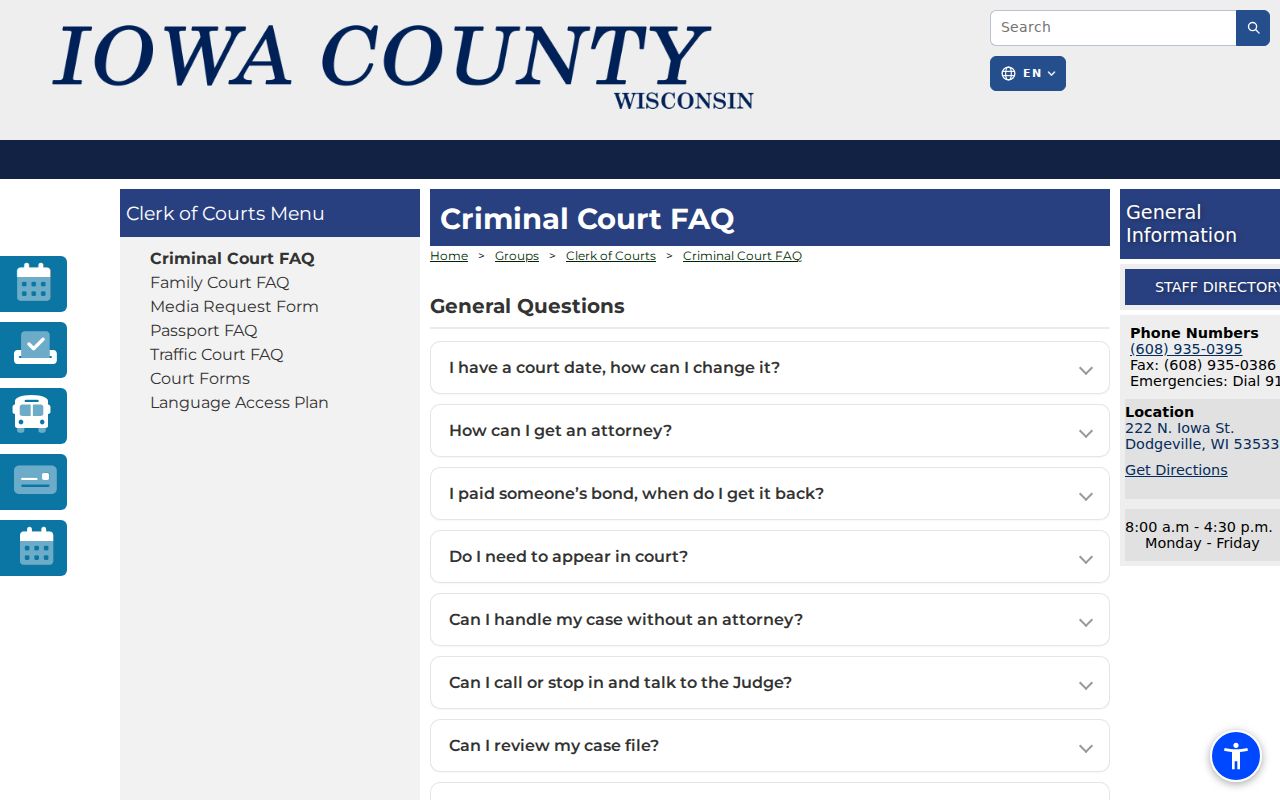
That county page connects public access, retention, and the clerk fallback in one place. Bring the year, caption, class, and number when you know them.
The Iowa County clerk page carries the current counter route.
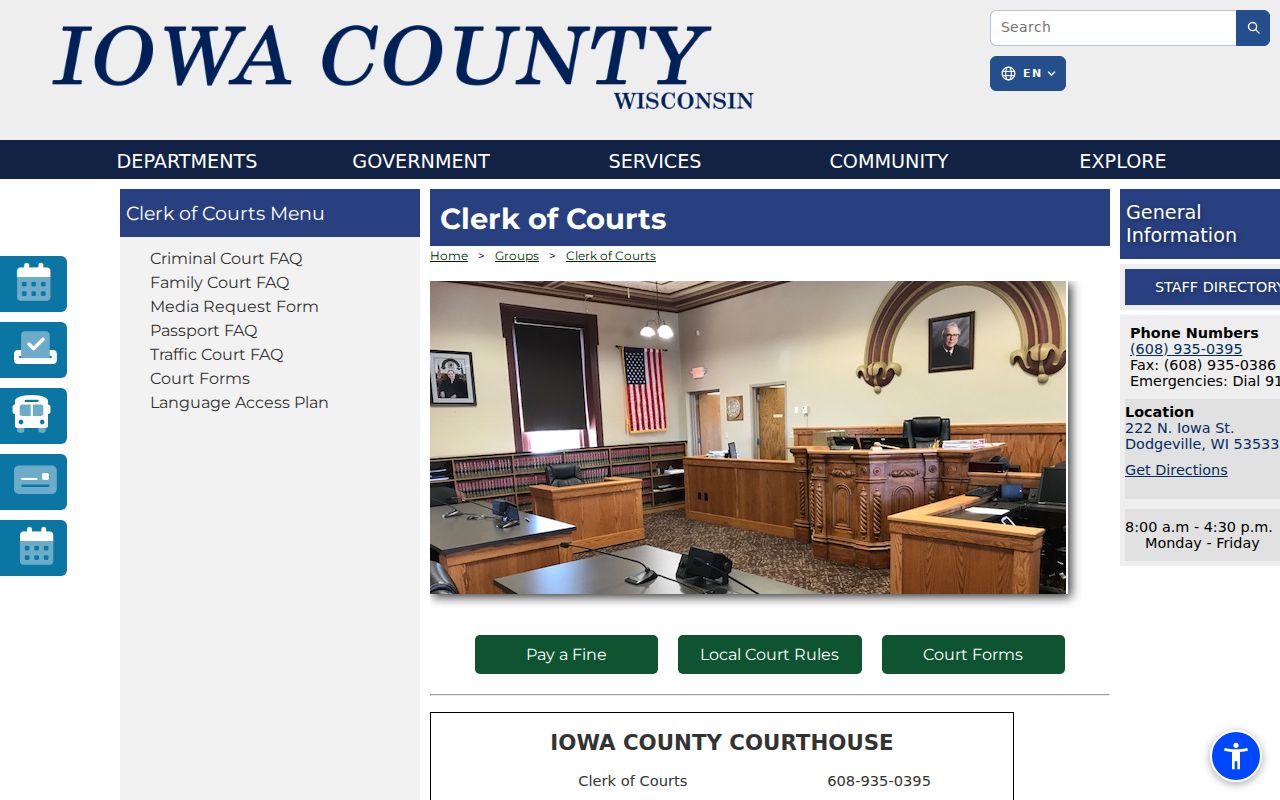
The Clerk of Circuit Court, not the general County Clerk, keeps criminal circuit records.
Iowa County Clerk Copy Route
A printout from WCCA carries no certification. For a real certified copy of an Iowa County filing, order, or judgment, contact the clerk of courts. Name the document you need. Have the case number ready. Add the event date, the copy type, where it should go, and a callback number. Ordinary copies run $1.25 per page, payable in advance. The state schedule tacks on $5 for certification.
The clerk can walk you through procedure but cannot act as your lawyer. Warrant questions should go to your attorney. The District Attorney is at (608) 935-0393. The State Public Defender is at (608) 401-2030. For records and process help, call the clerk directly at (608) 935-0395. The county's official court forms source displays the forms the clerk accepts.
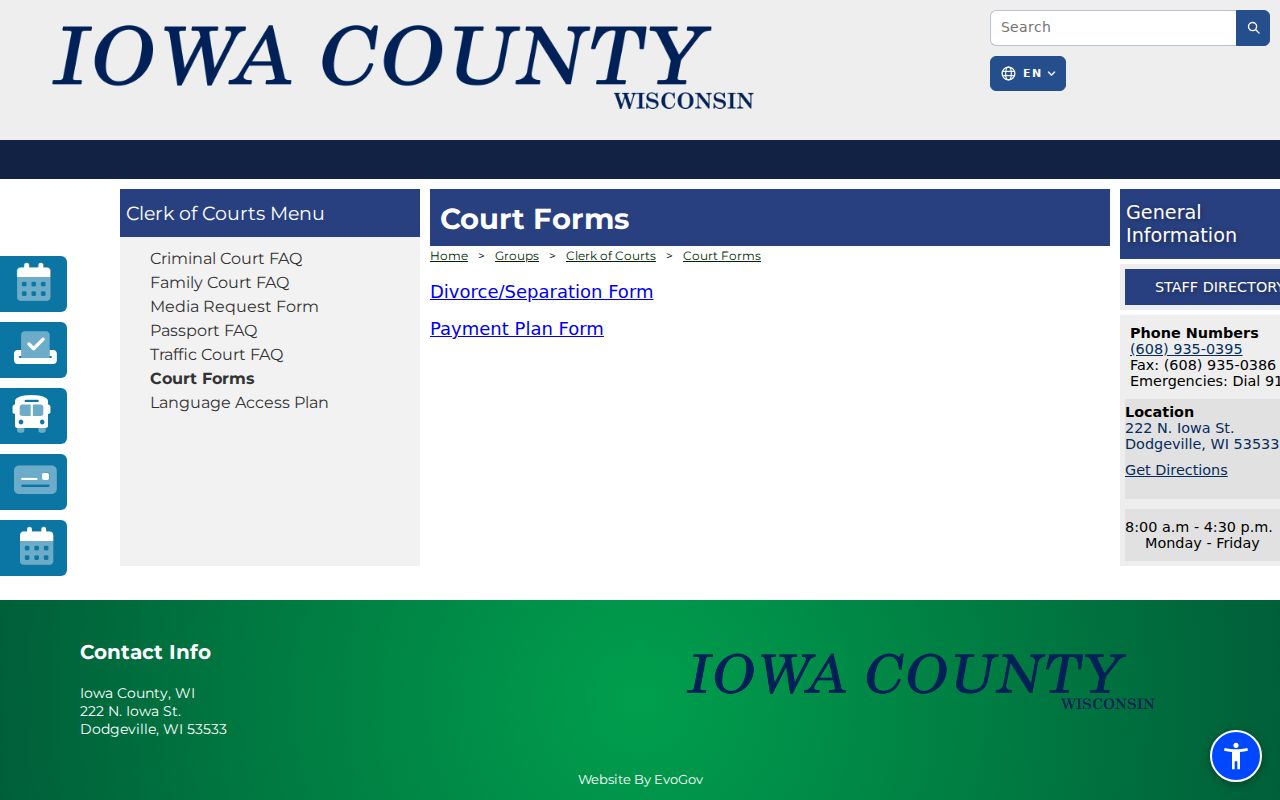
Check live instructions before sending a form because accepted methods depend on the item.
Sealed Dockets and Public Access
Wisconsin tilts toward open court records. Yet some information stays protected. Under Wis. Stat. §59.20(3), inspection of clerk papers is governed by statute and court rule. So a public Iowa County criminal docket can list a case's status and events. A protected filing can stay out of view.
Three labels matter here. Redacted data is simply stripped from an item that remains public. Confidential material is restricted by law or rule. Sealed material is closed by court order. One caution: a blank docket result does not prove the case never existed.
Key rules: §801.19 protects identifiers; §801.20 governs confidential documents; and §801.21 governs sealing motions and orders.
When access is limited, ask which authority controls the record and whether a redacted copy can be released. The court makes the sealing decision; the clerk alone cannot.
Verify the current Iowa County criminal docket and any certified judgment with the Clerk of Circuit Court before relying on a result.