
Searching Iowa County Civil Dockets
Most people begin with Wisconsin Circuit Court Access, known widely as WCCA. It is free and searchable from home. A case number produces the cleanest match. Without one, copy the spelling from a complaint, summons, or notice and select Iowa County. Because a statewide name search can pull similar names from many counties, check the county, case type, filing date, and party role before opening a record.
WCCA is not the only route. Call the Iowa County Clerk of Circuit Court at (608) 935-0395, visit the counter at the Iowa County Courthouse, 222 N. Iowa Street, Dodgeville, or send a mailed inquiry. The counter also has a public-access computer. Fax at (608) 935-0386 works only where county instructions permit, and local rules cap ordinary fax transmissions at six pages excluding the cover. Email is not a general filing route.
- Open WCCA and accept the portal terms presented on the live site.
- Enter the full Iowa County case number, or enter the party's last and first names.
- Select Iowa County and narrow the result with the civil classification when offered.
- Match the caption, filing date, party role, and status before opening case details.
- Call or visit the clerk when a filed document, certified copy, or clarification is needed.
Iowa County WCCA Civil Search
WCCA offers the public view of case information maintained through Wisconsin's Consolidated Court Automation Programs. It stands apart from the authenticated e-filing service used by authorized filing parties. Searching costs nothing. Still, the result is a register-level view, not a promise of every document image. You might see that an order was entered on a date. You may still need the clerk's file to read it. That gap matters when exact language, signatures, exhibits, or certification are required.
The Wisconsin filing and classification page lays out how broadly the civil system is organized. The state's own interface appears here. It is the official source to start from before narrowing an Iowa County civil docket search.
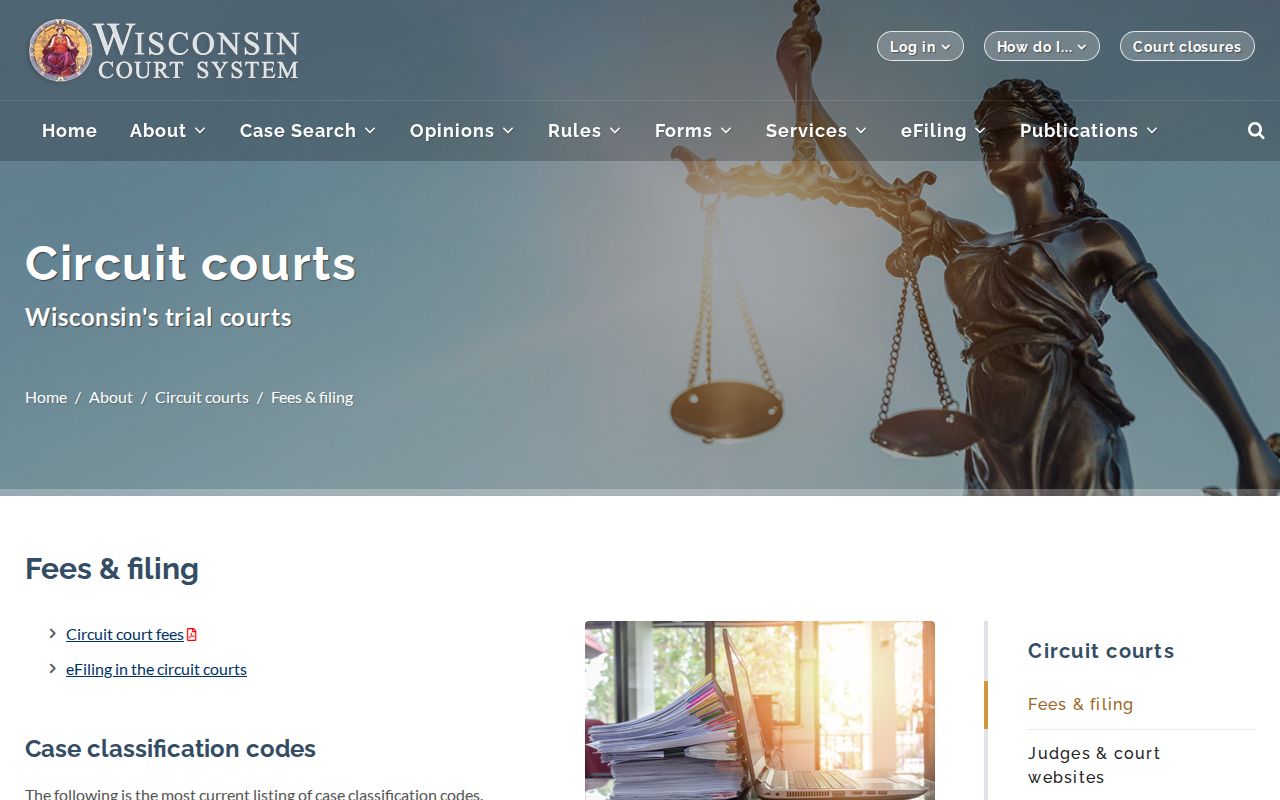
Classifications help steer a search. They cannot replace the caption, case number, or event history found in the actual Iowa County record.
Inside an Iowa County Civil Docket
Every Iowa County civil docket pairs a case header with a chronological register. The header names the circuit court, branch, classification, filing date, caption, party roles, attorneys where public, status, and assigned court official. The register then logs each procedural event. A complaint and proof of service come first. So do an answer, motion, affidavit, notice, conference, order, judgment, satisfaction, or appeal. Money judgment and garnishment matters may carry financial entries too. Ask the clerk to confirm any official balance or payoff.
| Case number | The court-assigned Wisconsin identifier, generally structured as YYYY-XX-######, with a year, classification code, and sequence. |
|---|---|
| Parties | Plaintiff or petitioner and defendant or respondent roles, plus attorneys when public. |
| Filings | Entries for complaints, petitions, answers, affidavits, proof of service, and notices. |
| Motions and settings | Requests for court action, scheduled events, continuances, hearings, and orders. |
| Outcome | Dismissal, default judgment, judgment, satisfaction, disposition, costs, or appeal references. |
Iowa County Entries Versus Filed Papers
One common mistake deserves attention. That is reading a short WCCA line as though it were the filed paper itself. An entry is only an index to an event. It can establish that an answer, motion, or order was entered. It may not show the text, attachments, or legal effect of that item. To verify what a paper actually says, go to the official court file. The Iowa County Clerk of Circuit Court holds it. That step matters most for judgments, scheduling orders, stipulations, and proofs of service.
Quick distinction: WCCA helps locate and track a public case. A clerk-issued copy supplies the paper behind an entry, and certification adds the clerk's official attestation.
Give the clerk the Iowa County case number, a document description, and the event date. Say whether you need a plain or certified copy. The county criminal FAQ lists ordinary copies at $1.25 per page, and the state circuit fee chart lists certification at $5 plus the per-page charge. Confirm the current amount before ordering.
Civil Case Types on the Docket
Wisconsin's classification system gathers many disputes under the civil umbrella. Family, probate, and small claims carry their own classifications and procedures. Two Iowa County WCCA results can look quite different. Both may still be civil in a broad sense. Pick the closest current classification, then verify the event list. Never assume every action follows one path.
- Money judgments, contract claims, and garnishment actions
- Mortgage or agricultural foreclosure and condemnation review
- Personal injury, wrongful death, malpractice, and property damage
- Small claims, including their own return and service events
- Divorce, paternity, other family, and probate matters where public access permits
Estates and probate proceedings may sit with the Register in Probate instead. That Iowa County office is in Room 2201 at the courthouse, reachable at (608) 935-0347. Identify the classification shown on the notice or WCCA result first.
Iowa County Small Claims Service
Small claims bring their own scheduling and service rules. Iowa County's local rules assign small-claims return scheduling mainly to the Clerk. The Judicial Assistant or deputies handle it as well. They also recognize certified-mail service under Wis. Stat. §799.12(2)-(3). A docket line may show that proof of service was filed. It may also show that an appearance occurred. That line alone does not decide whether every legal requirement was met.
- Return date
- The first scheduled small-claims court event shown in the case record or notice.
- Proof of service
- A filing about delivery of process; inspect the paper when its method or timing matters.
- Default judgment
- A judgment that may follow when a required answer or appearance is not made, subject to court procedure.
If service is disputed, request the filed proof from the Iowa County clerk. Then seek legal advice rather than draw a conclusion from the event label alone.
Civil Docket Settings and Hearings
Scheduling in Iowa County civil cases starts with the CCAP Calendar. The local rules treat it as the main place to look. A civil docket entry can list a return date. It can also list a scheduling conference, a motion hearing, mediation-related event, trial, review, or reset. The entry usually gives the date, time, branch, official, case number, and event type. That label is short, though. A mailed notice or a signed order can carry instructions the public entry never shows. So when two sources seem to disagree, call the clerk. The number is (608) 935-0395, and it is best to call before the setting.
One thing a reset is not: a dismissal. It simply moves an event. It should be followed by a new setting or a later notice. A scheduling conference can set deadlines for motions, discovery, settlement work, and trial preparation. It is not the trial itself. The Iowa County Court Dates page walks through the fuller process.
Iowa County Civil Mediation Notices
Iowa County's local rules add a detail worth knowing. It applies in foreclosure cases and credit-card or money-judgment actions. The plaintiff must tell the defendant that alternative dispute resolution or mediation may be available. On request, the court may order a settlement alternative or set a scheduling conference. That is why a docket reader can spot a notice, conference, or mediation-related order. It sits between the complaint and final resolution.
None of that means the parties settled. And if no public document image appears, the event may still have had written terms. Read the later entries for an order, dismissal, judgment, or continued schedule. When a deadline turns on an order, get the filed paper from the clerk. Do not trust the event title alone.
Iowa County Judgments and Satisfaction
The first judgment entry rarely closes the book on an Iowa County civil case. The register can later pick up costs, post-judgment motions, garnishment activity, a satisfaction, reopening, or a notice of appeal. "Disposed" means an outcome or closing event has been recorded. It does not block later enforcement or review. "Satisfaction" records that a judgment obligation was addressed in the manner the filed record reflects. It should never be inferred from a web result alone.
An Iowa County civil judgment can be appealed to Wisconsin Court of Appeals District IV. Search appellate matters in Wisconsin Supreme Court and Court of Appeals Case Access, not in WCCA. The circuit register may show a notice of appeal. WSCCA carries the appellate docket itself.
Civil Docket Access Rules
Wisconsin favors public access to court records. Yet that access does not reach every document or identifier. An Iowa County civil case can include redacted information. It can also hold a confidential paper or material sealed by court order. Juvenile, family, probate, health, and treatment records may carry added restrictions. A missing WCCA result does not prove no case exists. It may reflect a spelling issue, a new entry, a different jurisdiction, an older file, or an access restriction instead.
Key Wisconsin rules:
Wis. Stat. §59.20(3) addresses public inspection of clerk-held papers subject to law and court rules.
Wis. Stat. §801.19 protects Social Security, account, driver identification, passport, and similar numbers.
Wis. Stat. §801.21 governs motions and orders to seal court records.
Access to a paper denied? Ask the clerk whether a redacted copy is available. The court, not the clerk acting alone, decides a request to seal. An Iowa County civil docket works best for following one's own case. It also helps with confirming a public event, understanding local procedure, or doing historical research. The originating court file remains the final authority.