
Searching the Iowa County Court Docket
Start any Iowa County court docket search with the Wisconsin Court System Case Search page. That page sends circuit queries to Wisconsin Circuit Court Access, known as WCCA. Pick Iowa County when the case belongs in its circuit court. A complete case number works best. A name search can also work if you know the spelling and the party's role. What the public sees is case information, not a certified court file.
Follow this order in any situation. Track your own case, verify a notice, or look into a public matter:
- Read the citation or notice and identify the named court.
- Open WCCA and select Iowa County for a circuit matter.
- Search with the case number, or use the party name and case-type fields.
- Match the county, caption, filing date, and classification.
- Read the register and current settings, then ask the clerk for any filed paper needed.
A blank screen proves nothing. The case could be municipal, appellate, federal, too old for the online view, or restricted from display. The Iowa County Clerk of Circuit Court can search the local file index and the public-access computer at the courthouse for you.
WCCA and Iowa County Records
The clerk and WCCA do different jobs. Think of WCCA as the public window onto Wisconsin circuit case information. Where fields are public, it shows the case header, parties, classification, court events, financial entries, and upcoming settings. You can use it from home. Just do not expect a downloadable image of every complaint, motion, exhibit, or order.
| Route | Best use | Limit |
|---|---|---|
| WCCA | Find a public Iowa County case and read its register | Some records and images are not public online |
| Clerk counter | Inspect the public file or use a courthouse computer | Access is in Dodgeville |
| Phone or mail | Confirm the custodian and request copies | A precise case and document description helps |
| WSCCA | Follow a state appeal | It does not replace WCCA for circuit cases |
A printout from your browser is fine for personal notes. For anything official, get a certified copy from the custodian, since it carries the clerk's attestation. Before paying, ask the receiving office which form it actually requires.
Inside an Iowa County Court Docket
Every Iowa County court docket opens with a header and a dated register of actions. Wisconsin case numbers encode the year, the case class, and a sequence number. A felony might carry a code like 2026-CF-###. Other categories use their own two-letter classes. Those codes help separate files belonging to people with similar names.
| Case number | Year, case class, sequence, and county. |
|---|---|
| Parties | Public party and attorney roles when applicable. |
| Register entries | Filings, notices, motions, orders, hearings, and judgments. |
| Settings | Date, time, branch, official, and event type when public. |
| Disposition | The event that resolves a claim, charge, or case. |
| Financial fields | Fines, fees, restitution, judgments, or payments when relevant. |
Sometimes a docket entry notes that an order was filed but shows no text online. The clerk-held file holds the paper behind that line.
Iowa County WCCA Search Fields
Search with the fewest, most reliable facts you have. The WCCA interface changes over time, yet the core ideas stay: case number, party name, county, and case type. Filter by Iowa County rather than assuming every locally connected party filed here. Then check several fields before trusting any single match.
| Field | Use |
|---|---|
| Case number | Enter the number from the notice, including year and class. |
| Party name | Use the legal spelling and review party roles. |
| County | Select Iowa County for its circuit docket. |
| Case type | Narrow a broad result to the right class. |
| Filing date | Separate cases with similar captions. |
Once a match checks out, save the case number. It is the best key for a phone call, mailed request, counter visit, or later docket search. Skip sending protected identifiers for a routine public lookup.
Courts That Keep Dockets in Iowa County
General-jurisdiction trials in the Seventh Judicial District belong to the Wisconsin Circuit Court, Iowa County. Its docket covers criminal, civil, family, probate, small-claims, traffic, forfeiture, juvenile, and other circuit matters. Plenty of other cases travel through separate systems. An Iowa County connection alone does not put them here.
| Court | Scope | Route |
|---|---|---|
| Iowa County Circuit Court | State trial and circuit traffic matters | WCCA or Clerk of Circuit Court |
| Municipal court | Local ordinance and municipal traffic matters | Citation and municipal clerk |
| Court of Appeals District IV | Appeals from circuit rulings | WSCCA |
| Federal courts | Western District, bankruptcy, and federal appeals | PACER or federal clerk |
Probate and protective filings of certain kinds sit with the Iowa County Register in Probate. Ask that office first, before sending any request, to confirm it holds the file.
Two Iowa County City Docket Routes
Each incorporated city in Iowa County takes its own route. Under Dodgeville's official 2024 attorney-contract material, city ordinance cases go to Iowa County Circuit Court. For those matters, WCCA and the circuit clerk are the practical routes. Still, a current citation controls. It controls if it names a different forum.
Mineral Point shows up in Wisconsin municipal-court material with a Municipal Justice Court. The city posts no public search portal. Begin instead with the citation, the municipal clerk, and the live state directory. Should a matter be appealed or transferred, the later filing may surface in WCCA.
Start with the paper: use the court and date printed on the current citation or notice, then confirm changes with that court.
How to Find Iowa County Court Dates
For scheduling, Iowa County local rules point to the CCAP Calendar as the primary resource. A public case view can list plenty. It may show the date, time, branch, court official, case number, caption, and event type. Traffic and small-claims returns are mostly scheduled by clerk staff. The Register in Probate handles probate and protective settings. A judicial assistant sets other circuit matters, or the court does so directly.
Always check the latest docket entry against any written notice. If they disagree, call the clerk. Use the number on the current directory or notice. A reset is not a dismissal, and an initial appearance is not a trial. The Iowa County court dates page walks through the full confirmation chain.
- Setting
- A scheduled event with a date, time, and type.
- Continuance
- A court-approved move to a later date.
- Return date
- An initial response date, not always a trial.
- Disposition
- The recorded result that resolves a case stage.
Iowa County Dockets and Case Files
The public register is not the whole court file. It only indexes procedural activity. Behind it sit pleadings, affidavits, and exhibits. Proofs of service, orders, judgments, sentencing papers, transcripts, and audio requests sit there too. Even without a WCCA image, some public papers can be inspected through the clerk.
The Wisconsin CCAP overview shows how the system works from filing through disposition. It covers hearing minutes, future calendar entries, and financial obligations.
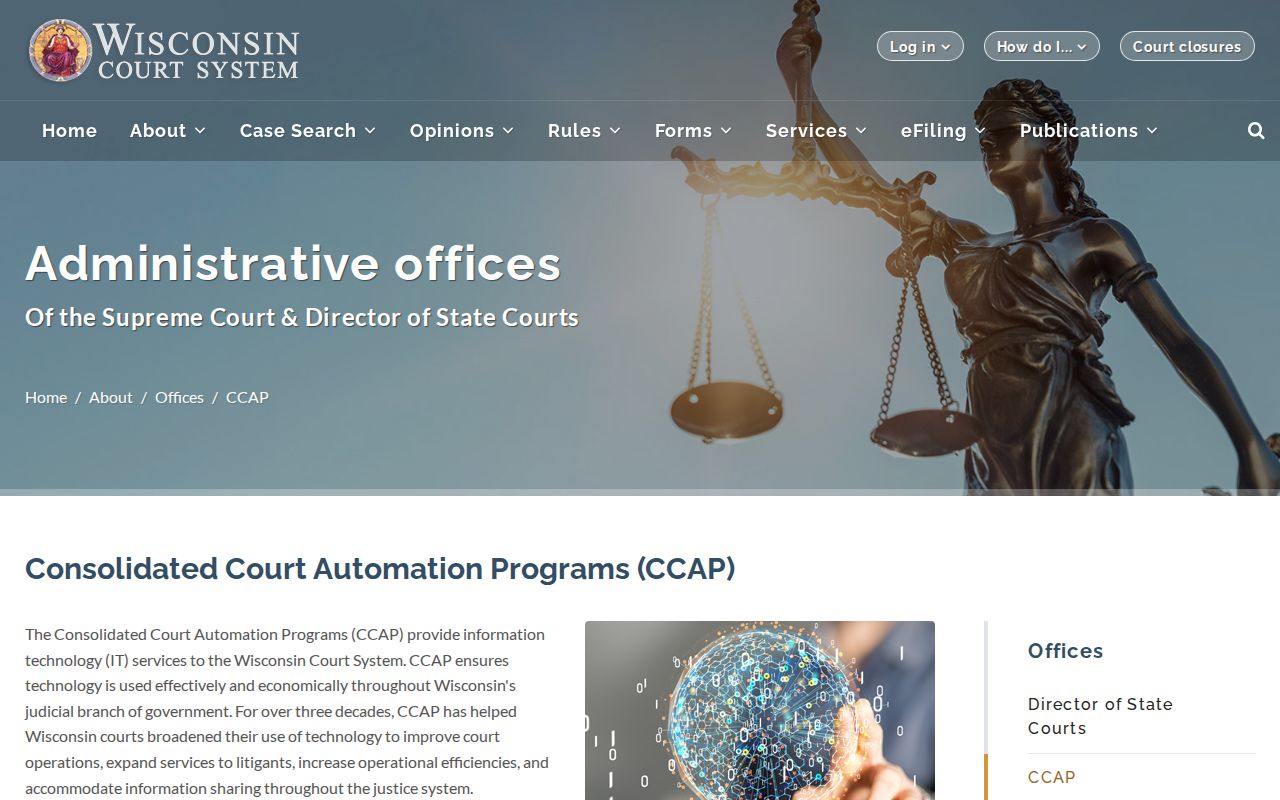
That official overview shows why WCCA, courthouse terminals, and clerk-held files are related yet distinct access layers.
Public Access to Iowa County Court Dockets
Inspection of clerk-held court papers is supported by Wisconsin law, but access has limits. Redaction strips protected data from an otherwise public paper. Confidential material stays withheld under a rule or statute. A sealing order can shut a document, part of a file, or an entire case. Juvenile, adoption, treatment, health, and similar sensitive records may follow special rules.
Key Wisconsin rules:
Wis. Stat. § 59.20(3) addresses custody and public inspection of clerk papers.
Wis. Stat. § 801.19 governs protected information.
Wis. Stat. § 801.20 addresses confidential documents.
Wis. Stat. § 801.21 sets the sealing process.
A blank result does not mean a record never existed. Ask the clerk whether a redacted copy exists, and which rule governs a denial. The court decides sealing, never the clerk alone.
Iowa County Caseload in Context
Iowa County handled a lot of paperwork in a year. The 2024 Wisconsin county caseload report shows 7,391 matters opened and 7,290 disposed in its Iowa County grand-total row. Treat those columns as statistical work, not headcounts of lawsuits, convictions, or people.
Most of the volume is traffic and forfeiture activity. Contested and uncontested rows sit apart. Transfers, reopened matters, and adjustments all shift the totals. That is why the case class and disposition field you choose matter so much.
The report also splits categories that blur together in a broad search. It lists 343 criminal felony matters opened. It lists 322 misdemeanors opened. It lists 135 criminal traffic matters opened. Civil, divorce, paternity, and other family each get their own rows. Contested and uncontested small claims do too. A big total tells you nothing about one case. Match the WCCA classification to the notice or filing first, then read the dated events. An opened count reflects the statistical work the report defines. A disposition count records case processing under that same scheme. Neither word gives you the text of a judgment. When a result shows a case as closed, pull the resolving entry. That means the final order, judgment, dismissal, conviction, or similar paper. Ask the Iowa County clerk for that paper when its exact terms matter. Aggregate court data is useful context, never proof about a party.
Docket Records at the Iowa County Clerk's Office
The Iowa County Clerk of Circuit Court holds circuit filings for the county. The office also holds proceeding information. Staff accept filings and payments, and they support access under confidentiality rules. They can help you locate a case or paper. What they cannot do is give legal advice. They cannot interpret an entry for a party or seal a record on their own.
Iowa County Clerk of Circuit Court
Iowa County Courthouse
222 N. Iowa Street
Dodgeville, WI 53533
(608) 935-0395
Have your details ready. Give the case number, the document or event date, and say whether you want a plain or certified copy. Call first if the file may sit with probate, a municipal court, an appellate court, or a federal clerk.
Iowa County Copy and Certification Costs
Fees change, so the live Wisconsin circuit fee chart is the place to confirm them. The chart lists a plain-copy rate of $1.25 per page plus a $5 certification charge on top of page costs. Probate follows its own schedule.
| Service | Captured amount |
|---|---|
| Plain circuit copy | $1.25 per page |
| Certified circuit copy | $5 plus $1.25 per page |
| Probate copy | $1 per page |
| Probate certification | $3 |
Ask the clerk for the current total and accepted payment methods. A WCCA printout works for personal tracking, but it is not a certified court record.
Iowa County Appeals Use WSCCA
An appeal moves you off the circuit search layer. Iowa County circuit appeals go to the Wisconsin Court of Appeals, District IV, and some later reach the Wisconsin Supreme Court. Search those dockets in WSCCA, not WCCA. That appellate docket carries its own number and entries for briefs, orders, submissions, opinions, and mandates.
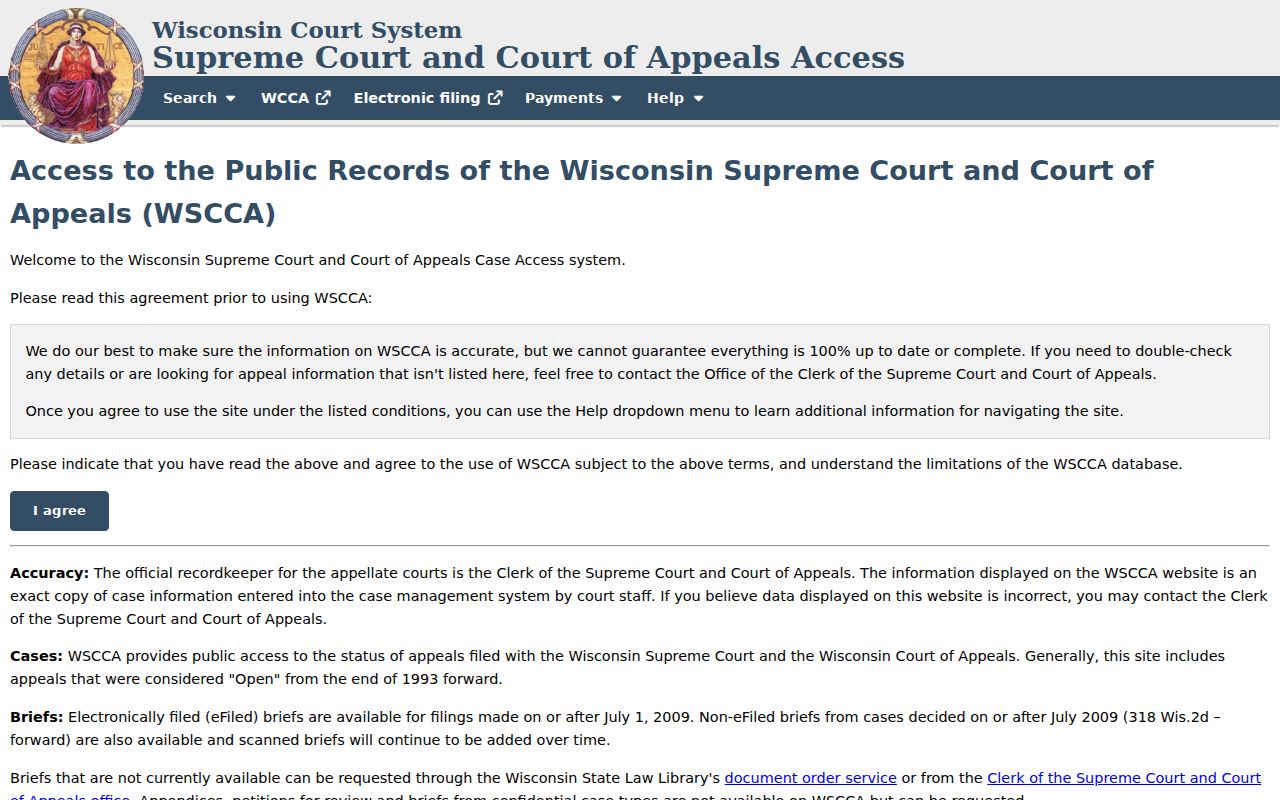
Once an Iowa County circuit ruling enters the state appeal system, the WSCCA interface is the public route in.
Federal matters sit apart entirely. The Western District of Wisconsin hears federal trial cases, its bankruptcy court keeps bankruptcy dockets, and federal appeals land at the Seventh Circuit. PACER or the right federal clerk holds those records.
When Iowa County Search Results Are Blank
Recheck the basics first: spelling, county, class, and number format. Then read the citation or notice for a municipal court. Mineral Point municipal matters can stay in that court, while Dodgeville city material routes some ordinance cases to circuit court.
- Use WSCCA for a state appeal.
- Ask the Register in Probate about probate files.
- Use PACER for federal matters.
- Ask the clerk about older files and the public terminal.
- Account for sealed, confidential, juvenile, or restricted cases.
Iowa County's FAQ lists retention periods of 20 years for criminal traffic and misdemeanors, 50 years for felonies, and 75 years for Class A felonies. Those periods guide how long records are kept. They do not promise online display.
Iowa County Court Dockets by City
Iowa County holds two incorporated cities. Dodgeville counted 4,984 residents and Mineral Point 2,565 in the 2020 Census. Population does not set jurisdiction, though. Every lookup starts with the court named on the filing, citation, or notice.
Dodgeville Docket Search
2020 population: 4,984
Official city material documents circuit-court routing for the ordinance arrangement studied.
Mineral Point Docket Search
2020 population: 2,565
State material lists a Municipal Justice Court, with no current public city portal found.
For any city matter, the current citation and the latest court notice are still the best proof of where the case is pending.
Map and Directions to the Iowa County Courthouse
Iowa County Circuit Court, the Clerk of Circuit Court, and the Register in Probate are all at the Iowa County Courthouse, 222 N. Iowa Street, in Dodgeville, the county seat. Because the courthouse address is shared by multiple county offices, ask for the Clerk of Circuit Court specifically rather than the county clerk. The building also has a public-access computer at the Clerk's counter for people without a convenient internet connection.
Iowa County Courthouse
Clerk of Circuit Court
222 N. Iowa Street
Dodgeville, WI 53533
(608) 935-0395
Monday through Friday, 8:00 a.m. to 4:30 p.m.
The local rules restrict courtroom photography and recording without a judge's permission and ask for advance notice for any planned media recording. For a disability accommodation, the local rules direct a caller to the County ADA Coordinator at (608) 935-0399 rather than the Clerk's line.